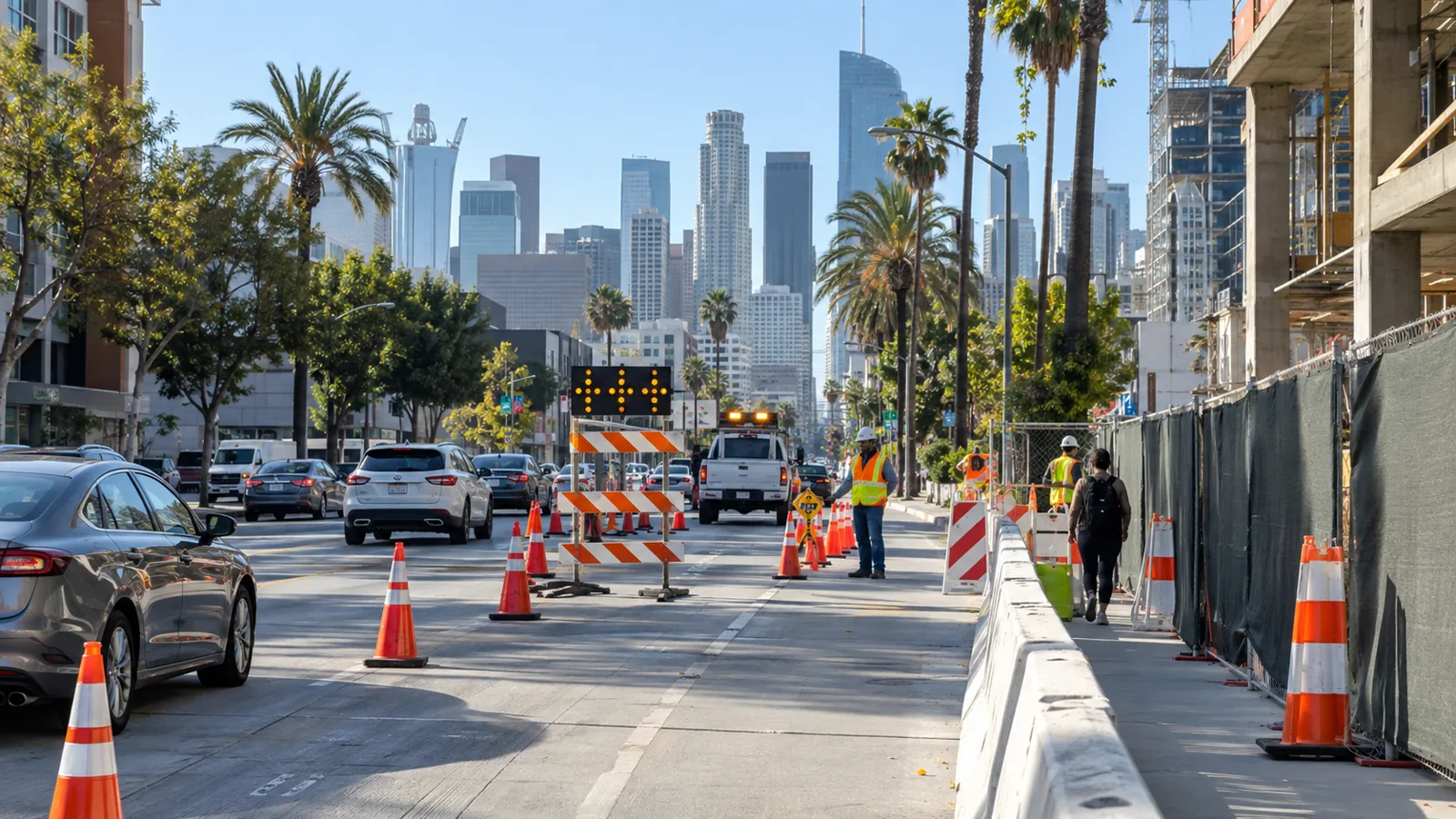
A full street closure is not the only impact
Lane narrowing, a closed sidewalk, crane setup, a dumpster, excavation, scaffolding, deliveries, or temporary no-parking zones can all change how the public moves through a work area. Start by identifying the smallest practical footprint for each construction phase.
What a traffic-control plan should communicate
- The exact work zone, equipment, storage, and protective devices
- Affected lanes, parking spaces, bike facilities, and sidewalks
- Safe pedestrian routing and accessible passage
- Proposed dates, work hours, setup, removal, and project phases
- Signs, cones, barriers, flagging, detours, and property access
- Transit, school, event, emergency, and neighborhood constraints
The plan should match field conditions and the proposed construction sequence. A generic diagram may not address site-specific access or roadway conditions.
Agencies and related permits
LADOT may have a role when traffic control, parking, or circulation is affected. StreetsLA, the Bureau of Engineering, or another agency may control the underlying construction or occupancy. Transit providers, utilities, or other public-safety coordination can also be relevant. An approval for construction does not necessarily authorize every closure or restriction.
A practical coordination sequence
- Identify the smallest workable public impact and alternatives.
- Separate the work into phases and describe each duration.
- Prepare site-specific traffic and pedestrian-control information.
- Confirm current agency instructions and any related coordination.
- Obtain applicable authorization before mobilization or public posting.
Review the street closure and traffic-control service overview when organizing a project intake.
Frequently asked questions
Can a contractor close a sidewalk for convenience?
Not automatically. Public-access impacts must be reviewed, and an accessible alternate route may be needed depending on the conditions.
Does a traffic-control plan guarantee the requested setup?
No. The responsible agencies determine what can be authorized and may request revisions based on roadway, transit, nearby project, or safety conditions.
Can lane and sidewalk impacts be reviewed separately?
They may involve different considerations, but the plans should remain coordinated so pedestrian and vehicle routes work together.
Official resources
Confirm current requirements with the Los Angeles Department of Transportation and the agency responsible for the underlying construction or occupancy.